
Recent disruptions show how much we depend on digital infrastructure. They also raise a broader question: are we ready for attackers who use AI to find weaknesses and move faster?
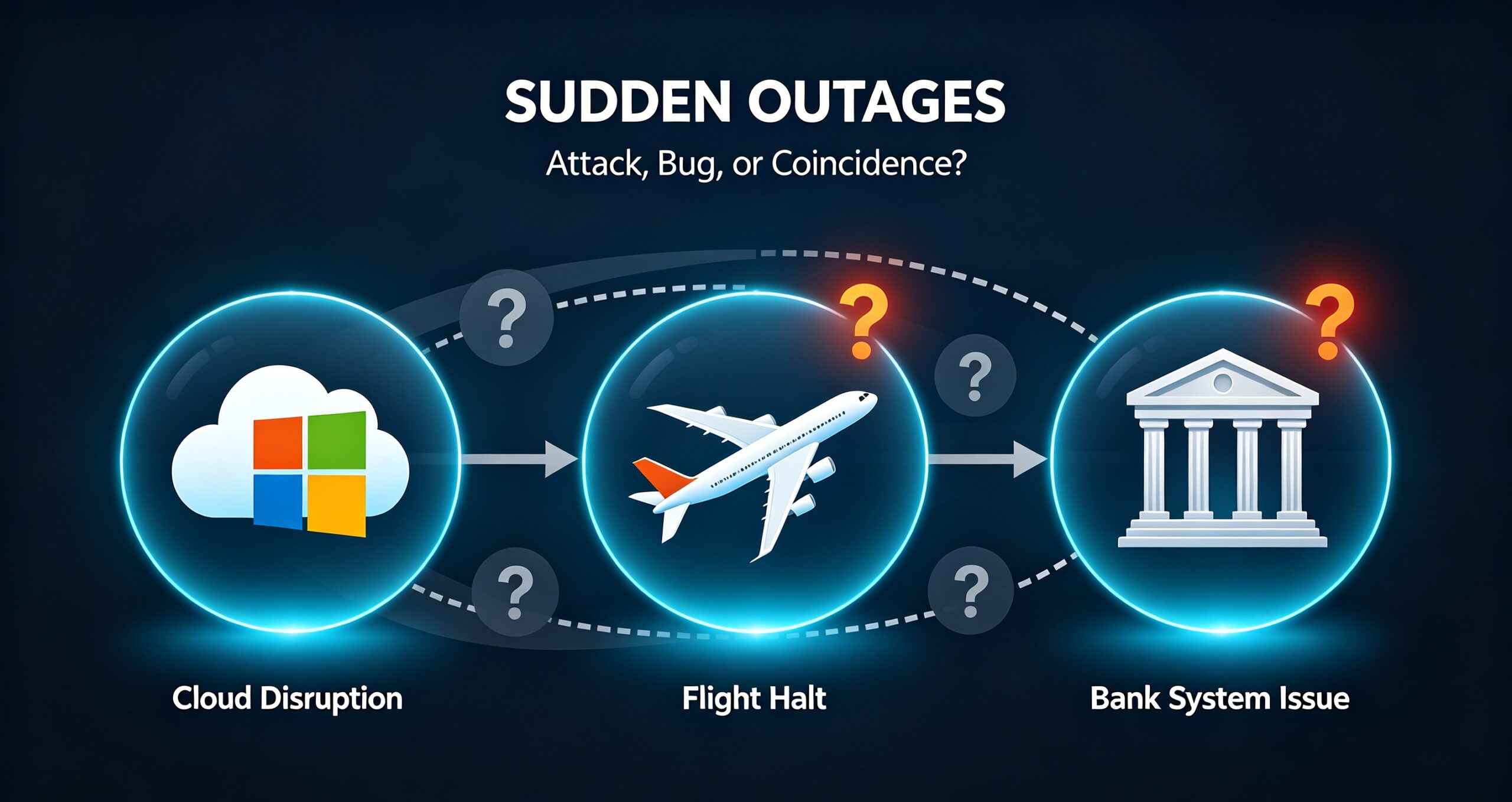
In November 2026, technical disruptions affected Microsoft services, U.S. air travel, and banking transactions. Each incident had its own circumstances. Together, they showed how quickly a technical failure can interrupt essential services.
As of November 17, 2026, public information does not establish that AI-assisted cyberattacks caused these disruptions or that the incidents formed a coordinated campaign. The FAA described technical instability in its communications network. Microsoft reported a network-related issue, while JPMorgan Chase attributed transaction delays to a software bug.
Sources: FAA · Associated Press on Microsoft · Reuters on banking disruptions
We should not turn uncertainty into an accusation. However, these events do invite a broader question. What happens when attackers deliberately use AI against complex systems that organizations already struggle to defend?
The Threat Is Real, Even When an Incident Is Not an Attack
AI-assisted cyber activity is no longer just a theoretical concern. In 2025, Anthropic reported disrupting a cyber-espionage campaign that used its AI tools across several stages. The company assessed that AI performed much of the tactical work, while people remained involved in key decisions. This was Anthropic’s assessment of one campaign. It does not show that attackers can automate every operation to the same degree. Read Anthropic’s report.
OpenAI also reported disrupting accounts associated with attempts to develop malicious cyber tools. The company noted that it could not independently verify activity outside its platform. These reports document AI misuse. They do not link AI to the aviation, banking, or Microsoft disruptions discussed above. Read OpenAI’s report.
AI does not instantly create an unbeatable attacker. However, it can make some tasks faster, cheaper, and easier to repeat. An attacker may use AI to analyze code, investigate weaknesses, or automate routine work. A skilled operator could use these capabilities to shorten the time between discovery and attempted exploitation.
AI systems also make mistakes. They can misinterpret results and may still depend on human direction. Defenders should take the risk seriously without overstating the technology’s current capabilities.
Why Speed and Resilience Matter
Security teams already face more alerts, vulnerabilities, and suspicious files than they can investigate manually. AI may help attackers test more ideas and adapt faster. In turn, defenders may have less time to identify and contain a threat.
Critical infrastructure deserves particular attention. Aviation, finance, healthcare, and utilities depend on interconnected systems and third-party services. Many also rely on technology built over decades. A failure in one component can affect organizations far beyond the original source.
This risk applies to both accidents and deliberate attacks. Organizations therefore need to ask more than whether an incident involved an attacker. They should also test how quickly they can detect a compromise, isolate affected systems, and restore essential services.
AI Must Also Strengthen Defense
The same technology can help defenders. Responsible teams can use AI to support vulnerability research, malware analysis, alert triage, and threat intelligence. AI can help analysts connect information faster. People must still verify the evidence and remain accountable for decisions.
Security teams should not treat AI-generated findings as facts without validation. They must distinguish malicious behavior from benign activity and understand their data’s limitations. An automated response based on a false conclusion can itself cause disruption.
At VirusSign, we believe security research and threat intelligence should help defenders act with confidence. Reliable evidence, careful analysis, and human accountability remain essential.
A Practical Approach to Responsible AI
No single safeguard can prevent every misuse. AI providers, organizations, researchers, and policymakers each have a role to play.
Set Proportionate Safeguards
AI providers should evaluate advanced cyber capabilities before release. They should apply proportionate access controls, monitoring, and abuse-response procedures to high-risk uses. At the same time, clear authorization and review processes should protect legitimate security research.
Limit Agent Access and Strengthen Security Basics
Organizations should give AI agents only the permissions they need. They should isolate sensitive environments and require human approval for consequential actions. Teams also need useful logs and a reliable way to stop an agent.
Basic security still matters. Organizations should maintain asset inventories, patch systems promptly, and use multifactor authentication. Protected backups, network segmentation, and tested incident-response plans also reduce risk.
Share Intelligence and Test Recovery
Providers, researchers, infrastructure operators, and public agencies should share actionable threat information where appropriate. They should also protect privacy, sensitive investigations, and legitimate research.
Critical-service operators should regularly exercise recovery plans. They should examine dependencies on common providers and test whether essential functions can continue during an outage. Resilience depends on safe and timely recovery as well as prevention.
Address Misuse Without Blocking Research
Policymakers and industry should focus on unauthorized access and harmful conduct. Rules should establish proportionate accountability while protecting authorized vulnerability research and responsible disclosure. Overly broad restrictions could weaken the research that helps make systems safer.
These proposals reflect the broader risk-management approach in NIST’s work on AI and secure development. They provide a starting point, not a guarantee against misuse. See the NIST AI Risk Management Framework and the NIST secure development profile for generative AI.
The Question Is Preparedness
Each recent disruption deserves an investigation on its own merits. We should not call these events AI attacks without evidence. At the same time, documented misuse of AI gives the security community a reason to prepare now.
AI will increasingly support both attackers and defenders. Our challenge is to encourage its benefits while making misuse harder and limiting the consequences of failure. People must remain accountable for how they build and deploy these systems.
The future of cybersecurity will depend not only on how powerful AI becomes, but also on how responsibly we build, govern, and use it.
– VirusSign Threat Intelligence